a black and white living room with a large tv

From Investment to Impact: Building Semiconductor Ecosystems in Arizona and Upstate New York


The Next Street Institute brought together leaders from Arizona and Upstate New York to explore how two regions at the center of America’s semiconductor growth are translating major investment into opportunities for local businesses, suppliers, workers, and communities.

Building on the recent report “Building Semiconductor Ecosystems in Arizona and Upstate New York” from the Next Street Institute, the conversation examined two semiconductor ecosystems at different stages of development, and what their experiences can teach other regions working to turn industrial investment into lasting economic growth.


Key Takeaways
  • Major Investment Is Only the Starting Point: Attracting an anchor manufacturer can create significant new demand, but it does not automatically translate into opportunities for local businesses. Suppliers need visibility into where opportunities exist, when demand will come online, what buyers require, and what capabilities they need to compete. Building the ecosystem around an investment is a much longer process.

  • Supplier Development Must Reflect the Regional Market: Arizona and Upstate New York demonstrate that there is no one-size-fits-all model for semiconductor ecosystem development. Arizona is building on an established semiconductor base, while Upstate New York is organizing a more coordinated regional system around new investment. The right approach depends on the maturity of the market, existing businesses and institutions, and the structure and timing of buyer demand.

  • Supplier Programs Work Best When Connected to Real Demand: Panelists emphasized the importance of helping businesses understand where they realistically fit in the semiconductor value chain and connecting supplier development to actual procurement needs. Buyers ultimately shape the opportunity through their purchasing needs, qualification requirements, contracting timelines, and supplier networks.

  • Building Supplier Capacity Requires More Than Technical Assistance: For many small and mid-sized businesses, the challenge is not simply whether they can make the product. Suppliers may need to invest in certifications, equipment, workforce, facilities, and other capabilities well before receiving their first purchase order. Panelists pointed to capital, timing, workforce development, shared infrastructure, and stronger connections to buyers as critical to reducing that risk and helping businesses enter the industry.

  • Success Should Be Measured by Commercial and Regional Outcomes: The ultimate measure of a strong semiconductor ecosystem is not simply the number of programs created or businesses served. Panelists pointed to supplier qualifications, first and repeat purchase orders, revenue growth and diversification, workforce advancement, talent retention, and the ability of economic benefits to reach businesses across a region as stronger measures of long-term impact.

A special thank you to our participants:

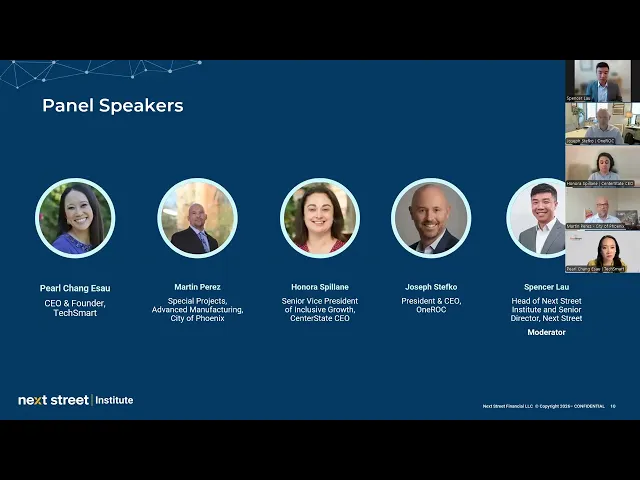
  • Pearl Chang Esau, CEO & Founder, TechSmart 

  • Martin Perez, Special Projects, Advanced Manufacturing, City of Phoenix  

  • Honora Spillane, Senior VP of Inclusive Growth, CenterState CEO  

  • Joseph Stefko, President and CEO, OneROC 

  • Spencer Lau, Head of Next Street Institute and Senior Director, Next Street (Moderator)

The Next Street Institute brought together leaders from Arizona and Upstate New York to explore how two regions at the center of America’s semiconductor growth are translating major investment into opportunities for local businesses, suppliers, workers, and communities.

Building on the recent report “Building Semiconductor Ecosystems in Arizona and Upstate New York” from the Next Street Institute, the conversation examined two semiconductor ecosystems at different stages of development, and what their experiences can teach other regions working to turn industrial investment into lasting economic growth.


Key Takeaways
  • Major Investment Is Only the Starting Point: Attracting an anchor manufacturer can create significant new demand, but it does not automatically translate into opportunities for local businesses. Suppliers need visibility into where opportunities exist, when demand will come online, what buyers require, and what capabilities they need to compete. Building the ecosystem around an investment is a much longer process.

  • Supplier Development Must Reflect the Regional Market: Arizona and Upstate New York demonstrate that there is no one-size-fits-all model for semiconductor ecosystem development. Arizona is building on an established semiconductor base, while Upstate New York is organizing a more coordinated regional system around new investment. The right approach depends on the maturity of the market, existing businesses and institutions, and the structure and timing of buyer demand.

  • Supplier Programs Work Best When Connected to Real Demand: Panelists emphasized the importance of helping businesses understand where they realistically fit in the semiconductor value chain and connecting supplier development to actual procurement needs. Buyers ultimately shape the opportunity through their purchasing needs, qualification requirements, contracting timelines, and supplier networks.

  • Building Supplier Capacity Requires More Than Technical Assistance: For many small and mid-sized businesses, the challenge is not simply whether they can make the product. Suppliers may need to invest in certifications, equipment, workforce, facilities, and other capabilities well before receiving their first purchase order. Panelists pointed to capital, timing, workforce development, shared infrastructure, and stronger connections to buyers as critical to reducing that risk and helping businesses enter the industry.

  • Success Should Be Measured by Commercial and Regional Outcomes: The ultimate measure of a strong semiconductor ecosystem is not simply the number of programs created or businesses served. Panelists pointed to supplier qualifications, first and repeat purchase orders, revenue growth and diversification, workforce advancement, talent retention, and the ability of economic benefits to reach businesses across a region as stronger measures of long-term impact.

A special thank you to our participants:

  • Pearl Chang Esau, CEO & Founder, TechSmart 

  • Martin Perez, Special Projects, Advanced Manufacturing, City of Phoenix  

  • Honora Spillane, Senior VP of Inclusive Growth, CenterState CEO  

  • Joseph Stefko, President and CEO, OneROC 

  • Spencer Lau, Head of Next Street Institute and Senior Director, Next Street (Moderator)